Why In News?
The government sanctioned 111 road projects with a budget of ₹2,481.93 crore under the Vibrant Villages Programme-I (VVP-I).
What is the Vibrant Villages Programme (VVP)?
Centrally Sponsored Scheme: Government approves the Vibrant Villages Programme-I (VVP-I) In February 2023, to target 662 priority villages across 19 districts in Arunachal Pradesh, Himachal Pradesh, Sikkim, Uttarakhand, and Ladakh.
VVP-II Expansion: Government introduces VVP-II (2024-25 to 2028-29) as a 100% centrally funded scheme with an outlay of ₹6,839 crore to cover additional international land borders.
Key Features of the Newly Approved Road Projects
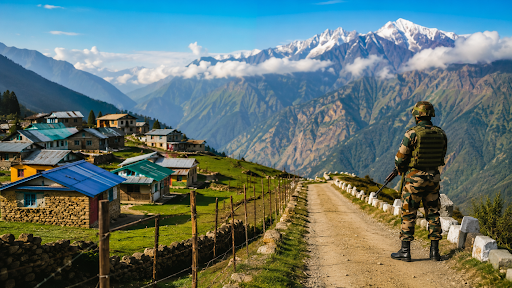
All-Weather Road Connectivity: The 111 road projects build all-weather access to 134 remote villages, ensuring transport remains open during rain, snow, and rough seasonal conditions.
Strategic Military Importance: These roads allow the Indian Army and Border Guarding Forces to move troops and military equipment quickly to the Line of Actual Control (LAC).
Surveillance Capabilities: Improved access boosts military surveillance capabilities and prepares forces to respond instantly to any hostile activities.
Socio-Economic Benefits: New roads connect isolated communities to major markets, which sharply boosts local trade, agriculture, and border tourism.
Essential Services Access: The infrastructure provides rapid access to healthcare and education, thereby lifting the overall standard of living for border populations.
Significance of the Programme
National Security Reinforcement: A populated border village serves as a civilian checkpost, helping the military gather fast and accurate intelligence about enemy movements.
Migration Reduction: By supplying fundamental needs like 4G mobile networks to 528 villages and piped drinking water to 625 villages, the program motivates people to live permanently in border areas rather than migrating to cities.
Balanced Regional Development: The VVP uses a "hub and spoke model" to build social entrepreneurship and applies the "one village one product" concept to celebrate local heritage.
Disaster Management Support: Sturdy all-weather roads function as vital lifelines, enabling fast rescue and relief operations during natural disasters like flash floods or earthquakes.
Major Challenges
Difficult Himalayan Terrain: Construction across steep mountains, deep river valleys and geologically unstable slopes requires tunnels, long-span bridges and advanced engineering, increasing project complexity and execution time.
Harsh Weather Conditions: Heavy snowfall, avalanches, cloudbursts and prolonged freezing temperatures shorten the working season and frequently damage border roads and bridges.
Environmental & Ecological Sensitivity: Himalayan region is ecologically fragile; road cutting, blasting and deforestation can trigger landslides, habitat fragmentation and biodiversity loss, necessitating strict environmental safeguards.
High Construction & Maintenance Costs: Transporting construction material, machinery and manpower to high-altitude border areas significantly increases project costs, while recurring repairs after landslides and floods impose a heavy maintenance burden.
Conservation vs Development: Expanding roads, tourism and settlements without scientific carrying-capacity assessments may degrade fragile ecosystems and accelerate environmental risks.
Disaster Vulnerability: Earthquakes, glacial lake outburst floods (GLOFs), flash floods and landslides frequently disrupt connectivity and delay project completion.
Border Depopulation: Continuous migration of youth from remote border villages reduces local workforce availability and weakens socio-economic resilience.
Logistics & Supply Chain Constraints: Limited transport corridors and long distances from urban centres delay the supply of construction materials and equipment.
Measures to Enhance Border Development
Complete Road Projects on Time: Ensure strict monitoring and milestone-based implementation of road projects to provide all-weather connectivity before harsh winter conditions.
Strengthen Integrated Infrastructure: Simultaneously develop roads, optical fibre networks, 4G/5G mobile towers, power supply and drinking water infrastructure to create digitally connected border villages.
Promote Border Tourism & Local Entrepreneurship: Encourage homestays, eco-tourism, cultural festivals, handicrafts and local markets to generate sustainable livelihoods and reduce outward migration.
Build Disaster-Resilient Infrastructure: Construct climate-resilient roads, avalanche protection structures, modular bridges, slope stabilisation systems and advanced drainage to minimise disruptions caused by natural disasters.
Strengthen Community Participation: Empower Vibrant Gram Sabhas to prepare Village Action Plans, monitor project implementation and improve transparency through participatory governance.
Improve Health & Education Infrastructure: Deploy Mobile Medical Units, establish SMART classrooms, telemedicine facilities and digital learning centres to improve human development indicators in border villages.
Strengthen Digital Governance: Integrate BharatNet, e-Governance platforms, GIS mapping and drone-based monitoring to improve service delivery, project monitoring and administrative efficiency.
Promote Convergence of Schemes: Ensure effective convergence with schemes such as PMGSY, Jal Jeevan Mission, PM-KUSUM, Digital India and Skill India for holistic development.
Enhance Border Livelihoods: Promote high-value horticulture, medicinal plants, agro-processing, wool-based industries and women-led Self-Help Groups (SHGs) to improve rural incomes.
Conclusion
The Vibrant Villages Programme acts as a powerful shield for India's integrity by transforming isolated border settlements into developed, fully connected, and highly secure communities.
Source: PIB
|
PRACTICE QUESTION Q. Consider the following statements regarding the Vibrant Villages Programme (VVP-I): 1. It is a Centrally Sponsored Scheme focused on developing border villages. 2. It exclusively covers villages located along the borders of North-Eastern states. Which of the statements given above is/are correct? (A) 1 only (B) 2 only (C) Both 1 and 2 (D) Neither 1 nor 2 Answer: (A) Explanation: Statement 1 is correct: The Government of India approved the Vibrant Villages Programme-I (VVP-I) explicitly as a Centrally Sponsored Scheme aimed at the comprehensive development of border villages. Statement 2 is incorrect: VVP-I does not exclusively cover villages in North-Eastern states. It spans across the northern border, including the states of Himachal Pradesh, Uttarakhand, Sikkim, Arunachal Pradesh, and the Union Territory of Ladakh. |