Why In News?
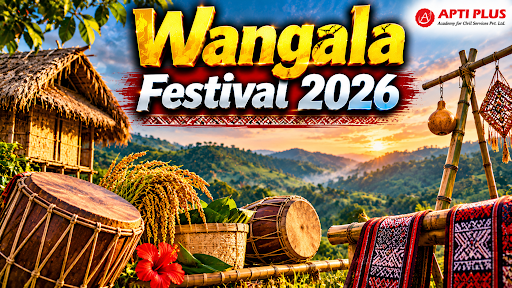
The 50th (Golden Jubilee) Hundred Drums Wangala Festival is being held from 11 to 14 November 2026 at Wangala A·dam, Chibagre, near Tura in West Garo Hills, Meghalaya.
What Is Wangala?
Origin Of The Festival Format: The organised “Hundred Drums” festival was first held on 6–7 December at Asanang, near Tura, in the late 1970s, turning village celebrations into a shared Garo cultural event.
Meaning And Purpose
-
Post-Harvest Thanksgiving: Wangala marks the end of the harvest and thanks Misi Saljong, the Sun God and giver of fertility, for a good crop.
-
Timing: Traditionally celebrated in October–November, after the main harvest.
-
Spread: Celebrated by Garos in Meghalaya, parts of Assam and Bangladesh.
Key Rituals
|
Ritual |
What Happens |
|
Rugala |
The Nokma (village chief) pours rice beer as an offering to Misi Saljong |
|
Cha·chat So·a |
Burning of incense to honour the deity |
|
Hundred Drums Dance |
Rows of men beating long dama drums and women dancing in step, in feathered headgear |
Traditions
-
Day 1 (Rugala & Cha-chat So-a): Performed inside the village chief's (Nokma) house by a priest (Kamal), involving offerings of rice beer (bitchi), cooked rice, and burning incense.
-
Day 2 and Onwards (Kakkat / Dama Gogata): Young and old people dress in colorful traditional attire with feathered headgears and perform the traditional Dama Dagota dance in parallel lines of men and women to the beat of long oval drums, gongs, and primitive buffalo-horn flutes.
Music And Performers
-
Instruments: Dama (long drum), Kram, gongs, adil (buffalo horn trumpet) and bamboo flutes.
-
Participants: Young women (nomil) and men (pante) form the dance lines.
-
Wangala Anthem: The folk song "Dimdim Dimchong Dachichong", composed by Millickson K. Sangma, is sung on each day of the festival.
Who Are The Garos?
|
Feature |
Details |
|
Self-name |
A·chik (A·chik Mande, "hill people") |
|
Region |
Garo Hills of western Meghalaya; also Assam and Bangladesh's Mymensingh region |
|
Language |
Garo, of the Bodo–Garo branch of Tibeto-Burman languages |
|
Social system |
Matrilineal: descent through the mother; a chosen daughter (nokna) inherits family property |
|
Traditional faith |
Songsarek; most Garos are now Christian |
|
Traditional institution |
Nokpante, a bachelors' dormitory for training youth |
-
Tribal State: Scheduled Tribes form about 86% of Meghalaya's population, according to the 2011 Census.
-
Self-Governance: The Garo Hills Autonomous District Council functions under the Sixth Schedule, with powers over land, forests and customary law.
-
Ecology: The Garo Hills host the Nokrek Biosphere Reserve (in UNESCO's network since 2009) and Balpakram National Park.
Other Harvest Festivals
|
Festival |
Community / State |
Note |
|
Nongkrem |
Khasi, Meghalaya |
Five-day festival for harvest and prosperity |
|
Behdienkhlam |
Pnar (Jaintia), Meghalaya |
Ritual to drive away plague and disease |
|
Hornbill |
Nagas, Nagaland |
"Festival of festivals", held in December |
|
Bhogali Bihu |
Assam |
Post-harvest festival in January |
|
Nuakhai |
Western Odisha |
Offering of new rice |
Source: HINDUSTANTIMES
|
PRACTICE QUESTION Q. Consider the following statements regarding the Wangala Festival:
Which of the statements given above is/are correct? (a) 1 and 2 only (b) 2 and 3 only (c) 1 and 3 only (d) 1, 2 and 3 Answer: (b) 2 and 3 only Explanation: Statement 1 is incorrect. Wangala is the most significant post-harvest festival of the Garo tribe (also known as A'chik), not the Khasi tribe. It is celebrated mainly in the Garo Hills of Meghalaya, as well as parts of Assam, Nagaland, and Bangladesh. Statement 2 is correct. The festival is held to express gratitude to Misi Saljong (also called Pattigipa Ra'rongipa), the Sun God of fertility, for blessing the community with a rich harvest. Statement 3 is correct. Widely known as the 100 Drums Festival, it marks the end of a long period of agricultural toil and heralds the onset of the winter season. |