Why In News?
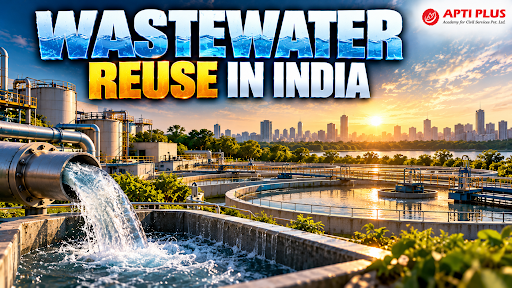
Maharashtra's severe drought highlights an urgent need to transition wastewater reuse from policy to practice by addressing treatment infrastructure gaps and weak implementation.
What Is The Current Status Of Wastewater Generation In India?
National Wastewater Footprint: India generates approximately 72,368 MLD (Million Litres per Day) of urban domestic sewage. (Source: Central Pollution Control Board).
Treatment Infrastructure Gap:
-
Installed Capacity: 31,841 MLD across 1,469 STPs (43.99% of total generation, including 376 STPs under construction or non-operational). (Source: CPCB)
-
Operational Treatment Capacity: 26,869 MLD (37.12% of generation) across 1,093 operational STPs. (Source: CPCB)
-
Actual Capacity Utilization: Only 20,235 MLD (27.96% of total generation) is actually treated. (Source: CPCB)
-
Untreated Sewage Volume: A massive 52,133 MLD (72%) of raw sewage flows untreated into natural water bodies, rivers, and drains. (Source: CPCB)
National vs Global Reuse Benchmarks: Globally, 11% of treated wastewater is reused, whereas India reuses only 5% to 6% of its generated wastewater. (Source: CWAS)
-
Puducherry: Reuses 26% of its generated wastewater
-
Haryana & Chandigarh: Reuse 16%
-
Delhi: Reuses 12.5%
-
Maharashtra: Generates 9,107 MLD of urban domestic sewage and 1,706 MLD of industrial effluent. Although it treats 4,242 MLD (47% utilized capacity), it productively reuses only 4% to 17%.
Dimension |
Linear Water Model ("Take-Make-Dispose") |
Circular Water Economy ("Use-Treat-Reuse") |
|
Water Sourcing |
Continuous, high-volume extraction of fresh groundwater or municipal water for every production cycle. |
Recycled water is continuously recirculated within process, cooling, and utility loops before fresh intake. |
|
Effluent Handling |
Effluent is treated (or under-treated) once and discharged directly into drains or rivers as waste. |
Effluent is treated and re-circulated as a core resource input; discharge is a last-resort residual. |
|
Sludge & By-Products |
Sludge and organic solids are sent to landfills or informally dumped. |
Sludge is valorized into agricultural compost, brick-making materials, or biogas energy feedstock. |
|
Supplier Relationships |
Transactional, one-way procurement of raw materials and treatment chemicals. |
Collaborative network connecting CETP operators, chemical suppliers, and recyclers in closed loops. |
|
Cost Structure |
Rising costs driven by freshwater tariffs, effluent cess, and environmental non-compliance penalties. |
Reduced freshwater and disposal costs, alongside potential municipal/industrial revenue from recovered resources. |
|
Regulatory Posture |
Reactive compliance focused solely on avoiding immediate penalties from MPCB/CPCB norms. |
Proactive compliance embedded in infrastructure design, enabling eco-labeling and market access. |
|
Health Outcome |
Elevated health risk for factory workers and downstream communities from untreated discharges. |
Reduced health exposure through consistent treatment and safe, closed-loop contaminant handling. |
What Is The Policy Architecture For Wastewater Reuse In India?
Constitutional Foundation
-
State Subject Jurisdiction: Under Article 246 (Seventh Schedule, List II - State List, Entry 17), water supply, drainage, embankments, and water storage are primary State subjects.
-
Union Regulatory Enablement: Under Article 246 (Seventh Schedule, List I - Union List, Entry 56), Parliament regulates inter-state rivers and river valleys in the public interest.
-
Local Body Mandates: Under Article 243W (Twelfth Schedule, Entries 5 & 6), water supply, public health, sanitation, and conservancy are devolved to Urban Local Bodies (ULBs).
Statutory Acts & Central Frameworks
-
The Water (Prevention and Control of Pollution) Act, 1974: Empowers State Pollution Control Boards (SPCBs) to enforce effluent discharge standards for municipal sewage and industrial units.
-
Ministry of Power Tariff Policy, 2016 (Para 6.2(5)): Strictly mandates that all Thermal Power Plants (TPPs) located within a 50 km radius of a municipal STP must mandatorily utilize treated sewage water for plant cooling operations.
-
National Framework on Safe Reuse of Treated Wastewater (SRTW) 2022: Issued by the Ministry of Jal Shakti / NITI Aayog to establish fit-for-purpose quality standards, commercial business models, and an "Apna Jal" circular economy approach.
-
Urban Missions: AMRUT 2.0 and Swachh Bharat Mission Urban (SBM 2.0) mandate circular water management, targeting a 20% reduction in urban freshwater demand and 40% reduction in industrial freshwater intake.
Progressive State Policy Models
-
Maharashtra State Water Policy, 2019: Mandates a minimum of 30% recycled water reuse across urban local bodies within 5 years.
-
Safe Reuse & Management of Treated Wastewater Policy, 2025 (GoM): Mandates City Wastewater Reuse Plans, establishes a State Wastewater Monitoring Cell, requires PPP/BOOT financing, and mandates off-take for housing societies, data centers, and industrial estates.
-
Gujarat Policy for Reuse of Treated Wastewater (2018): Sets a binding target to reuse 75% of treated wastewater by 2025 and 100% by 2030.
Why Do Wastewater Policies Falter On The Ground?
Distorted Pricing Economics: Unregulated, low-cost groundwater extraction and subsidized freshwater tariffs eliminate any financial incentive for bulk industrial users to buy treated recycled water.
Conveyance Infrastructure Gap: While cities construct treatment plants (STPs), they fail to build secondary and tertiary distribution grids ("purple pipes") to transport recycled water directly to industrial clusters.
ULB Fiscal Deficit: STP capital costs (₹1 Crore/MLD) and annual state-wide O&M expenses (₹630.6 Crore/annum in Maharashtra) far exceed annual municipal sewerage tax collections (₹1,367 Crore in 2019–20), leaving local bodies unable to fund distribution lines. (Source: CWAS)
Systemic STP Failure Modes: Routine operational failures occur when operators switch off continuous aeration blowers to cut power costs (causing dissolved oxygen to fall below 2–4 mg/L), combined with lack of power backup, neglect of sludge wasting, and untrained personnel.
Institutional Fragmentations & Overlaps: Overlapping jurisdictions between State Pollution Control Boards (SPCBs/MPCB), Water Resources Regulatory Authorities (MWRRA), and Municipal Corporations create accountability voids, delaying regulatory enforcement.
Heavy Metal Contamination and Mixed Sewage Inflows: Industrial effluents often mix illegally with domestic municipal sewage lines, introducing heavy metals (lead, chromium, cadmium) that standard biological STPs cannot remove, rendering effluent unfit for agricultural reuse.
-
Example: Panchaganga and Godavari River Pollution, continuous discharge of partially treated industrial and domestic effluents in Kolhapur and Nashik has caused chronic eutrophication and toxic fish kills.
Contractual Failures in PPP Models: Private concessionaires under Hybrid Annuity Models (HAM) abandon plants when municipal bodies fail to guarantee timely annuity payments or fail to establish off-take agreements with industrial buyers
Way Forward
Mandatory Industrial and Thermal Off-Take Agreements: Enforce Ministry of Power norms by denying fresh surface-water drawal permits to thermal power plants and steel mills operating within 50 km of municipal STPs.
-
Example: Nagpur Municipal Corporation - MAHAGENCO Model, where treated sewage from the Bhandewadi STP is piped to the Koradi Thermal Power Station for boiler and cooling operations, freeing up drinking water for millions.
Linking Payments to Performance: Scale up Hybrid Annuity Models (HAM) where the urban local body or state government pays 40% capital cost during construction, with the remaining 60% paid as structured annuities over 15 years tied to strict effluent water quality benchmarks.
-
Example: Varanasi and Mathura HAM STP Projects, ensuring the private operator remains financially committed to operation and maintenance (O&M) performance.
Decentralized Sewage Treatment (D-STP): Amend municipal building bye-laws to mandate on-site decentralized wastewater treatment systems and dual-plumbing networks in all commercial complexes and residential townships exceeding 20,000 sq meters.
-
Example: Bengaluru Model Building Bye-Laws, requiring apartment complexes with over 20 units to install captive STPs and recycle reclaimed water internally for secondary flushing and horticulture.
Disincentivizing Groundwater Extraction: Rationalize water pricing by levying steep volumetric extraction cess on industrial groundwater extraction, making tertiary-treated wastewater economically attractive.
-
Example: Water Reuse Certificates / Tradable Water Entitlements, conceptualized by NITI Aayog to allow industries recycling beyond statutory quotas to trade certified credits with water-deficient entities.
Conclusion
Transforming wastewater management from a municipal disposal burden into a closed-loop, revenue-generating resource is a strategic economic imperative for securing India's long-term urban and industrial water security.
Source: DOWNTOEARTH
|
PRACTICE QUESTION Q. Despite comprehensive water policies, Indian urban centers remain vulnerable to meteorological droughts due to linear water management models. Discuss. 150 words |