Why In News?
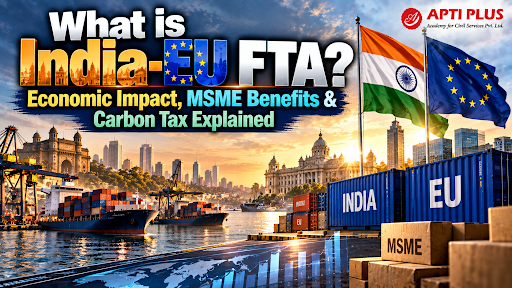
India and the European Union have accelerated negotiations on Free Trade Agreement spanning goods, services, and green trade standards.
What is the India-EU FTA?
The India‑EU Free Trade Agreement (FTA) between India and the European Union, designed to eliminate or reduce tariffs on over 90% of traded goods and expand cooperation in services, investment, and sustainability.
-
Trade in Goods: Aims to eliminate customs duties on over 90% of tariff lines, boosting two-way merchandise flows exceeding $130 billion annually.
-
Trade in Services: Facilitates cross-border services, addressing Mode 1 (digital delivery) and Mode 4 (mobility of skilled Indian IT professionals).
-
Investment Protection: Standalone Bilateral Investment Treaty (BIT) negotiation to guarantee non-discriminatory investor treatment and fair dispute resolution.
-
Market Access: Dismantles non-tariff barriers, quota restrictions, and complex sanitary and phytosanitary (SPS) bottlenecks for mutual trade.
-
Rules-Based Trade: Aligns trade governance with WTO core principles, establishing transparent customs clearance and anti-dumping disciplines.
-
Intellectual Property: Balances rigorous patent protections with public health safeguards under the TRIPS Agreement for affordable generic medicines.
-
Sustainable Development: Integrates legally binding chapters on climate commitments, biodiversity preservation, and core ILO labour standards.
Why is the EU Important for India?
Large Consumer Market: Offers direct access to a 27-nation single market boasting 450 million high-income consumers with massive purchasing power.
Major Trading Partner: Stands as India’s second-largest goods trading partner after the US, accounting for over 10% of India’s global trade.
Investment Source: The EU is one of the largest FDI sources in India, contributing over $100 billion cumulatively to infrastructure and auto sectors.
Technology Partner: Key provider of advanced European industrial tooling, precision robotics, and cutting-edge aerospace engineering.
Advanced Manufacturing: Critical partner in localizing high-end semiconductor assembly, specialty chemicals, and automotive manufacturing.
Green Technology: Catalyzes India’s green transition through joint ventures in offshore wind, green hydrogen electrolysers, and smart power grids.
Research and Innovation: Facilitates joint R&D through initiatives like Horizon Europe, advancing biopharma, AI governance, and materials science.
Strategic Significance of the India‑EU FTA for India
|
Dimension |
Explanation |
|
Supply‑Chain Resilience |
|
|
Economic Diversification |
|
|
Strategic Autonomy |
|
|
Technology Cooperation |
The FTA institutionalizes collaboration under the EU‑India Trade & Technology Council (TTC) — covering clean‑tech transfers, satellite communications, cybersecurity, and trusted AI protocols, enhancing India’s digital sovereignty. |
|
Green Transition |
Mobilizes European blended green finance and carbon‑credit mechanisms to decarbonize India’s heavy industries, supporting national net‑zero by 2070 targets and complementing the Green Credit Programme. |
What are the Major Challenges?
EU Standards: The European Union’s stringent sanitary, phytosanitary, and chemical regulations impose high compliance costs. Smaller Indian agricultural and chemical exporters struggle to meet these norms, risking exclusion from EU markets.
Carbon Border Adjustment Mechanism (CBAM): Effective from 2026, CBAM levies carbon tariffs on energy‑intensive imports such as steel, aluminium, and cement. This could erode India’s cost advantage unless domestic industries adopt low‑carbon technologies.
Labour and Environmental Standards: EU’s insistence on linking trade preferences to child‑labour prohibition, unionisation rights, and carbon‑reduction commitments may trigger legal and diplomatic friction with India’s domestic labour laws.
Competition for Indian Producers: Duty‑free inflow of European dairy, automobile, and wine products threatens local cooperatives and MSMEs, especially in rural and semi‑urban markets.
Rules of Origin: Strict origin criteria demanding high domestic value addition hinder Indian exporters from qualifying re‑exported goods for zero tariffs, limiting supply‑chain flexibility.
Regulatory Compliance: Complex conformity‑assessment and certification protocols under EU law create prohibitive testing and documentation costs for Indian micro‑enterprises.
Sensitive Agricultural Sectors: Domestic opposition remains strong against opening tariff lines for European dairy, wheat, and poultry, as these could undercut smallholder farmers and distort rural livelihoods.
Way Forward
Accelerating Domestic Green Steel and Aluminium Transitions: Deploy viability gap funding for hydrogen-based green steel production to bypass CBAM levies.
-
Example: National Green Hydrogen Mission, earmarking green hydrogen pilots specifically for decarbonizing the primary steel sector.
Harmonizing Quality Conformity Assessment Frameworks: Negotiate Mutual Recognition Agreements (MRAs) to validate Indian laboratory test results in the EU.
-
Example: Export Inspection Council (EIC) Traceability Portals, ensuring real-time digital phytosanitary compliance for EU-bound agricultural exports.
Establishing Dedicated MSME Technical Compliance Desks: Subsidize European standard certification, REACH testing, and sustainable packaging upgrades for MSMEs.
-
Example: ZED (Zero Defect Zero Effect) Certification Scheme, subsidizing clean technology and quality compliance for small enterprises.
Negotiating Bilateral Carbon Equivalence Mechanisms: Urge the EU to recognize India’s domestic Carbon Credit Trading Scheme (CCTS) to offset CBAM liabilities.
-
Example: Bureau of Energy Efficiency (BEE) Carbon Market Framework, operationalizing a compliance carbon market across heavy manufacturing.
Upgrading Trade Logistics and Port Infrastructure: Expand dedicated freight corridors and automated green customs channels to cut export transit lead times.
-
Example: PM Gati Shakti National Master Plan, integrating multimodal transport links to reduce Indian port logistics costs toward 8% of GDP.
Conclusion
A balanced India-EU FTA will cement a rules-based economic partnership, provided domestic green manufacturing transitions outpace incoming carbon border adjustments.
Source: ECONOMICTIMES
|
PRACTICE QUESTION Q. Examine how the proposed India-EU Free Trade Agreement can catalyze India’s manufacturing exports while analyzing the compliance challenges posed by the Carbon Border Adjustment Mechanism. (10 Marks, 150 Words) |