Why In News?
The 2026 ADIPEC agreement highlights the rise of "Physical AI," an industrial shift that deploys AI into physical machinery to solve engineering challenges and overcome the tech sector's monetization hurdles.
What Is The ADNOC–OpenAI–G42 Deal?
-
AI Agents In Energy: ADNOC will use OpenAI Frontier, launched in February 2026, to connect and coordinate AI agents across its operations.
-
Sovereign Infrastructure: The system will run OpenAI's GPT models on G42's UAE-based sovereign AI infrastructure, combined with ADNOC's industrial data.
-
Existing Base: It will work alongside ENERGYai, ADNOC's subsurface AI platform, and more than 200 existing AI applications.
-
Human Oversight: Humans will remain in charge of critical decisions.
-
Cybersecurity: ADNOC will use OpenAI's Daybreak Blue initiative to strengthen cyber defences for critical energy infrastructure.
-
Workforce Training: The partners will train ADNOC staff to use the new tools.
What Is Physical AI?
Meaning
-
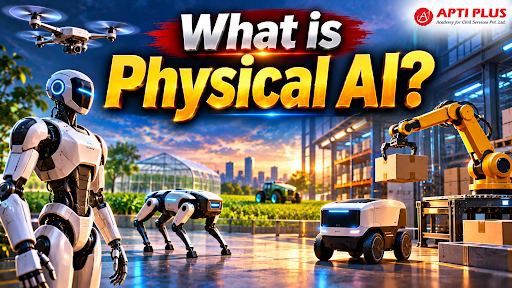
AI That Acts: Physical AI refers to AI systems that perceive the physical world through sensors, reason about it and act on it, through robots, vehicles, drones or industrial machines.
-
Beyond Chatbots: Unlike generative AI, which produces text or images, physical AI must deal with gravity, friction, motion and safety in the real world.
How It Works
|
Component |
Role |
|
Sensors |
Cameras, LiDAR, radar and touch sensors collect real-world data |
|
AI models |
Interpret data, plan actions and make decisions |
|
Actuators |
Motors, arms and wheels carry out actions |
|
Simulation and digital twins |
Virtual copies of real environments used to train and test AI safely |
|
World models |
AI models that learn how the physical world behaves |
-
Industry Push: Chipmaker NVIDIA popularised the term and launched Cosmos, a family of "world foundation models" for training robots and autonomous vehicles, in January 2025.
Applications
-
Industry And Energy: Inspection robots, predictive maintenance and automated plants.
-
Example: In 2025, ADNOC partnered with robotics firm Gecko Robotics to use robots that collect physical data on assets such as pipelines and tanks, feeding AI systems for maintenance.
-
Transport: Self-driving cars and trucks.
-
Healthcare: Surgical robots and assistive devices.
-
Agriculture: Drones and robots for spraying, sowing and crop monitoring.
-
Space And Defence: Robots for space missions, bomb disposal and surveillance.
How Big Is The Global Physical AI Shift?
-
Industrial Robots: The International Federation of Robotics (IFR) reported about 5.4 lakh new industrial robots installed worldwide in 2024.
-
Robot Density Leaders: South Korea has the world's highest robot density, with over 1,000 robots per 10,000 manufacturing workers.
-
Driverless Cars: In the US, Waymo was providing about 2.5 lakh paid driverless rides a week by 2025.
-
Humanoid Robots: Companies including Tesla, Figure and Unitree are developing humanoid robots for factories and homes.
Where Does India Stand?
-
Robotics Installations: India is among the world's top markets for new industrial robot installations, with about 9,000 units installed in 2024, but its robot density remains low.
-
National Strategy: MeitY released a draft National Strategy on Robotics in 2023.
-
IndiaAI Mission: Approved in March 2024 with an outlay of ₹10,372 crore, it supports compute, datasets and AI startups.
-
Space Robotics: ISRO's humanoid robot Vyommitra is set to fly on an uncrewed Gaganyaan mission.
-
Agricultural Drones: The Namo Drone Didi scheme, approved in 2023, provides drones to women self-help groups for agricultural services.
-
Social Innovation: Kerala start-up Genrobotics developed Bandicoot, a robot for cleaning manholes, to end dangerous manual scavenging.
What Are The Key Challenges?
Safety Risks
-
Real-World Harm: Unlike chatbot errors, mistakes by physical AI can cause injury or death.
-
Example: In 2018, an Uber self-driving test car struck and killed a pedestrian in Tempe, Arizona, the first known pedestrian death involving a fully autonomous vehicle.
Job Displacement
-
Automation Pressure: Robots could replace workers in manufacturing, warehousing and driving, which are major employers in India.
-
Skill Gaps: Many workers lack the skills to move into new, technology-based roles.
Legal And Liability Gaps
-
Who Is Responsible: It is unclear who is liable when an autonomous machine causes harm: the maker, the software developer, the operator or the owner.
-
No Specific Law: India has no comprehensive law on autonomous systems or robotics.
Data And Training Challenges
-
Scarce Real-World Data: Physical AI needs huge amounts of real-world sensor data, which is costly and slow to collect.
-
Simulation Limits: Behaviour learned in simulation does not always transfer perfectly to messy real-world conditions, the so-called "sim-to-real gap".
Cybersecurity Threats
-
Hacking Risks: Connected robots and industrial systems can be hacked, with physical consequences, especially in critical infrastructure such as energy and water.
High Costs And Import Dependence
-
Expensive Hardware: Advanced robots, sensors and chips are costly and mostly imported.
-
Chip Dependence: Physical AI relies on advanced semiconductors made by a handful of countries.
Energy Demand
-
Power-Hungry AI: AI training and data centres consume vast electricity. The International Energy Agency projects data centre electricity use could more than double by 2030.
What Is The Way Forward?
A Clear Regulatory Framework
-
Risk-Based Rules: Develop rules based on risk, with strict standards for high-risk uses such as autonomous vehicles and medical robots.
-
Example: The EU AI Act (2024) classifies AI used in safety components of machinery and vehicles as high-risk, requiring strict testing and human oversight, while the EU Machinery Regulation (2023) updates safety rules for AI-enabled machines.
-
Liability Rules: Clarify legal responsibility for harm caused by autonomous systems.
Finalise A National Robotics Strategy
-
Policy Roadmap: Finalise the National Strategy on Robotics, with clear targets for manufacturing, healthcare, agriculture and defence.
-
Testbeds And Sandboxes: Create regulatory sandboxes and test zones for safe trials of physical AI.
Build Domestic Capability
-
Hardware Manufacturing: Support domestic production of robots, sensors and actuators through schemes like PLI.
-
Semiconductors: Use Semicon 2.0 to strengthen chip supply for AI and robotics.
-
Research Centres: Fund robotics and AI research at IITs and other institutions.
Prepare The Workforce
-
Reskilling: Train workers to operate, maintain and work alongside robots.
-
Human–Robot Collaboration: Promote "cobots" (collaborative robots) that assist workers rather than replace them.
Focus On Social Good
-
Dangerous Jobs First: Prioritise physical AI for hazardous work, such as sewer cleaning, mining and disaster response, building on models like Bandicoot.
-
Agriculture And Health: Use drones and robots to support small farmers and rural healthcare.
Strengthen Cybersecurity
-
Secure-By-Design: Require cybersecurity standards for connected robots and industrial AI, guided by CERT-In.
Ensure Sustainable Energy
-
Green Compute: Power AI infrastructure with renewable energy and improve efficiency of data centres.
Conclusion
Physical AI marks the next phase of artificial intelligence, as AI moves from screens into factories, roads, farms and energy plants. For India, physical AI offers gains in productivity, safety and social welfare, but it needs clear safety and liability rules, domestic manufacturing, a skilled workforce and strong cybersecurity to harness the benefits responsibly.
Source: INDIANEXPRESS
|
PRACTICE QUESTION Q. What is physical AI? How does it differ from generative AI, and what are its applications? (10 Marks, 150 Words) |