Why In News?
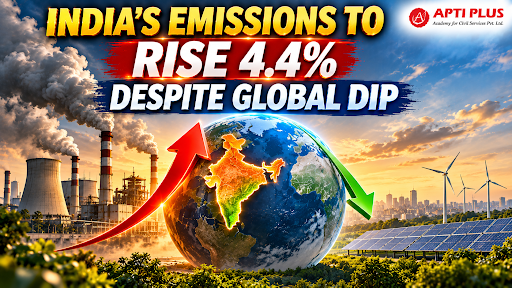
The Global Carbon Budget 2026, released by the Global Carbon Project and presented at COP31 in Antalya, Türkiye, projects that global fossil CO₂ emissions will fall by 0.4% in 2026. India's emissions, however, are projected to rise by 4.4%, driven mainly by coal.
What Is The Global Carbon Budget?
Annual Assessment: The Global Carbon Budget is an annual report by the Global Carbon Project that tracks carbon dioxide emissions, their sources and natural carbon sinks such as oceans and forests.
Scale: The 2026 edition was prepared by more than 140 scientists from over 90 institutions, led by Professor Pierre Friedlingstein of the University of Exeter.
Publication: It is published in the journal Earth System Science Data.
What Are The Key Findings?
Global Trends
|
Indicator |
2026 Projection |
|
Fossil CO₂ emissions |
38.2 billion tonnes, down 0.4% (range: –1.5% to +0.6%) |
|
Land-use emissions |
Rise to 5.1 billion tonnes from 4.4 billion |
|
Total CO₂ emissions |
A record 43.3 billion tonnes, up from 42.8 billion in 2025 |
|
Atmospheric CO₂ |
427.7 ppm, about 54% above pre-industrial levels |
|
Remaining 1.5°C budget |
About 150 billion tonnes, under four years of current emissions |
By Fuel
-
Oil: Down about 2%, largely due to price spikes linked to the Iran conflict and disruptions in the Strait of Hormuz.
-
Gas: Down about 0.3%.
-
Coal: Up about 0.6%.
By Country
|
Country / Region |
Share Of Global Fossil Emissions |
Change In 2026 |
|
China |
Largest emitter |
–0.9% |
|
United States |
13% |
–1.3% |
|
European Union |
— |
–1.5% |
|
Japan |
— |
–1% |
|
India |
8% |
+4.4% |
|
Rest of the world |
38% |
–0.7% |
India In Focus
-
Faster Than Average: India's 4.4% projected rise (range: +1.7% to +7.1%) is higher than its 3.5% average annual growth over the past decade.
-
Coal-Driven: India's coal emissions are projected to rise 5.9%, while oil emissions fall slightly by 0.9%.
-
Low Per Capita: India's per capita emissions in 2025 were only 2.2 tonnes, compared with 14.5 tonnes in the US.
A Note Of Caution
-
Not A Sustainable Decline: Lead author warned that a decline driven partly by geopolitical shocks is not a lasting climate solution.
-
Statistically Uncertain: Some experts note that the projected global fall is within the margin of error.
Why Are India's Emissions Rising?
-
Coal Dependence: Coal still generates about three-quarters of India's electricity.
-
Growing Energy Demand: Rapid economic growth, urbanisation, rising use of air conditioners and industrial expansion push up electricity demand. India's peak power demand reached about 250 GW in 2024.
-
Rising Coal Output: India's coal production crossed 1 billion tonnes in FY 2024–25.
-
Development Needs: As a developing country, India needs more energy to reduce poverty and improve living standards.
-
Industrial Acceleration: Emissions from heavy industries like steel and cement accelerated by 8% year-on-year, driven by a low industrial electrification rate.
-
Geopolitical Disruptions: Short-term shocks and supply disruptions in oil and gas forced a temporary pivot back toward coal and fossil-based backstops.
-
Expanding Livestock and Agriculture: Raising animals for milk and food (primarily dairy) makes up about 55% of India's agricultural emissions, adding a methane and greenhouse gas footprint.
How Should India's Emissions Be Viewed?
The Equity Argument
-
Low Historical Responsibility: India has contributed only about 3% of the world's cumulative CO₂ emissions since 1850, far less than the US and Europe.
-
Low Per Capita Emissions: India's per capita emissions are about one-third of the global average and a fraction of the US level.
-
CBDR-RC: Under the UNFCCC principle of Common But Differentiated Responsibilities and Respective Capabilities, developed countries are expected to lead in cutting emissions.
India's Climate Commitments
-
Updated NDC (2022): Reduce emissions intensity of GDP by 45% by 2030 from 2005 levels, and reach about 50% non-fossil power capacity by 2030, which India achieved in 2025.
-
Panchamrit (COP26, Glasgow, 2021): Includes 500 GW of non-fossil capacity by 2030 and net zero by 2070.
What Are The Key Challenges?
Heavy Reliance On Coal
-
Dominant Power Source: Coal generates around three-quarters of India's electricity, making emissions rise with demand.
-
New Coal Capacity: India plans to add coal-based capacity to meet peak demand and ensure energy security.
Rapidly Rising Energy Demand
-
Growth-Driven Demand: Electricity demand keeps rising with economic growth, heatwaves and new sectors such as data centres.
-
Peak Demand Pressure: Peak demand of about 250 GW in 2024 strained the grid, especially in the evening when solar output falls.
Intermittency And Storage Gaps
-
Solar Stops At Night: Renewable energy is variable and needs storage to replace coal around the clock.
-
Limited Storage: India's grid-scale battery and pumped storage capacity is still small compared with its needs.
Hard-To-Abate Sectors
-
Steel And Cement: These industries are difficult to decarbonise.
-
Trade Pressure: The EU's Carbon Border Adjustment Mechanism (CBAM), in its definitive phase from 2026, taxes carbon-intensive imports such as steel and aluminium, affecting Indian exporters.
Climate Finance Gap
-
Inadequate Funding: The $300 billion a year climate finance goal agreed at COP29 falls far short of developing countries' needs, estimated at about $1.3 trillion a year.
Land And Environmental Trade-Offs
-
Competing Land Uses: Large solar and wind parks need land and transmission lines, which can clash with ecology.
-
Example: In M.K. Ranjitsinh vs Union of India, the Supreme Court dealt with conflicts between transmission lines and the endangered Great Indian Bustard in Rajasthan and Gujarat, showing the trade-offs in expanding renewables.
Just Transition For Coal Regions
-
Livelihoods At Stake: Coal mining supports jobs and State revenues in Jharkhand, Chhattisgarh and Odisha. A rapid phase-down could hurt these regions.
What Is The Way Forward?
Accelerate Renewables With Storage
-
Scale Up Clean Energy: Expand solar, wind and hydro to meet the 500 GW target.
-
Invest In Storage: Use Viability Gap Funding for battery energy storage and pumped storage projects to provide round-the-clock clean power.
Modernise The Grid
-
Transmission Expansion: Strengthen the Green Energy Corridors to integrate renewable power across States.
-
Smart Grids: Use digital tools to balance supply and demand.
Boost Energy Efficiency
-
Proven Programmes: Expand successful efficiency schemes.
-
Example: The UJALA scheme distributed over 36 crore LED bulbs, saving billions of units of electricity and cutting emissions every year.
-
Industrial Efficiency: Strengthen the Perform, Achieve and Trade (PAT) scheme for energy-intensive industries.
Develop Clean Fuels And Nuclear
-
Green Hydrogen: Implement the National Green Hydrogen Mission, which targets 5 million tonnes of green hydrogen production a year by 2030.
-
Nuclear Power: Expand nuclear capacity, including small modular reactors under the Nuclear Energy Mission, towards the target of 100 GW by 2047.
Use Carbon Markets
-
Domestic Market: Operationalise the Carbon Credit Trading Scheme, 2023 to put a price on emissions.
-
International Markets: Use Article 6 of the Paris Agreement to attract investment through credible carbon credits.
Ensure A Just Transition
-
Support Coal Regions: Plan new jobs, skills and investment in coal-dependent districts.
-
Learn From Others: Other countries have planned coal transitions with regional support.
-
Example: Germany committed to phase out coal by 2038 and pledged large funds to support affected coal regions, offering lessons on protecting workers and communities.
Push For Equity And Finance Globally
-
Climate Justice: Continue to press developed countries at forums like COP31 to deliver finance, technology and deeper emission cuts.
-
Mission LiFE: Promote sustainable lifestyles through Mission LiFE, reducing demand-side emissions.
Conclusion
The Global Carbon Budget 2026 shows a world where fossil emissions are dipping slightly, largely due to an oil shock, while India's coal-driven emissions rise as its economy grows. India's low per capita and historical emissions give it a strong equity case, but its rising share makes clean growth essential.
Source: ECONOMICTIMES
|
PRACTICE QUESTION Q. India must balance its development needs with its climate responsibilities. Examine this statement and suggest a strategy for low-carbon growth. (15 Marks, 250 Words) |