Why In News?
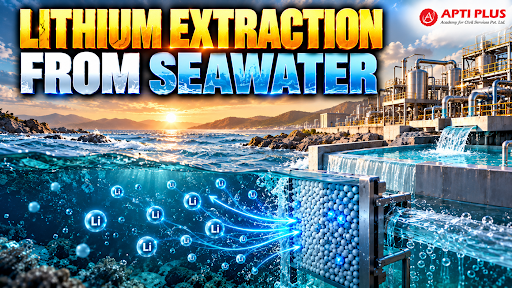
Scientists at the Bhabha Atomic Research Centre (BARC) have developed a chemical process that can recover nearly 90% of dissolved lithium from natural seawater.
What Is Marine Lithium Harvesting?
Marine Lithium Harvesting (also called "Blue Lithium" extraction) refers to the process of extracting dissolved lithium directly from seawater.
Marine harvesting offers a transformative alternative:
-
Abundant Supply: While terrestrial reserves are limited and unevenly distributed, the world’s oceans hold an estimated 180 to 230 billion tons of dissolved lithium—roughly 16,000 times more than known land-based deposits.
-
India's Strategic Autonomy: India currently suffers from 100% import dependence for raw lithium and battery-grade cells. Tapping ocean resources would safeguard domestic EV and energy storage goals against volatile global market shifts.
Core Scientific Challenge
Extracting lithium from seawater is historically difficult because it is ultra-dilute (only about 0.17 to 0.2 parts per million (ppm) or 0.17 mg per liter).
Seawater is packed with chemically similar monovalent and multivalent ions (like sodium, magnesium, and calcium). Magnesium ions, in particular, exist at thousands of times higher concentrations, making it tough for conventional filtration membranes to isolate lithium without heavy fouling or excessive energy use.
BARC Research
|
Extraction Technology |
Working Principle & Key Features |
|
BARC's Solvent Extraction Method |
1. Pre-treatment: Seawater pH is raised using sodium hydroxide and sodium carbonate, removing over 99% of interfering magnesium and calcium. 2. Extraction: An organic compound (dibenzoyl methane) dissolved in a solvent (methyl isobutyl ketone or MIBK) captures the lithium. 3. Stripping: Dilute nitric acid isolates the lithium, allowing 90% solvent reuse over multiple cycles. |
|
Electrochemical Cells |
Uses lithium iron phosphate (LFP) electrodes or specialized ceramic membranes (like LLTO) that selectively drive lithium transport using an electric current. |
|
Crown Ether Membranes |
Synthetic polymer rings designed with exact geometric precision to mimic biological ion channels, separating lithium from magnesium at high selectivity ratios. |
|
Solar-Powered Nanofiltration |
Utilizing solar energy to push seawater through selective filters, dropping the fossil-fuel energy footprint of the extraction. |
Challenges to Commercial Scalability
While lab results are highly promising, marine lithium harvesting faces scaling hurdles:
-
Ecological Impact: Disposing of highly concentrated chemical waste or altered brine back into the ocean could devastate local marine ecosystems.
-
Economic Viability: Moving thousands of tons of seawater to isolate small amounts of lithium requires heavy capital expenditure and operating energy.
-
Solvent Depletion: Even in efficient methods like BARC's, there is a roughly 10% physical loss of solvent per cycle that must be continuously replenished, adding to recurring costs.

Source: DOWNTOEARTH
|
PRACTICE QUESTION Q. The "Lithium Triangle", which accounts for a large portion of the world's identified terrestrial salt-brine lithium reserves, spans which of the following groups of countries? (a) Australia, China, and Canada (b) Chile, Argentina, and Bolivia (c) Brazil, Peru, and Colombia (d) South Africa, Zimbabwe, and Namibia Answer: (b) Explanation: The Lithium Triangle is an arid region of the South American Andes encompassing parts of Chile, Argentina, and Bolivia, home to over half of the world's identified terrestrial salt-flat (salar) lithium brine reserves. |