Why In News?
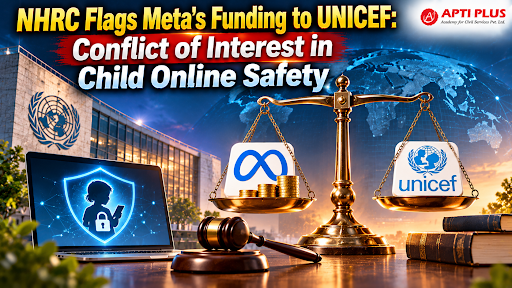
The National Human Rights Commission (NHRC) member Priyank Kanoongo formally wrote to the Union Women and Child Development (WCD) Secretary, escalating a complaint regarding the financial relationship between Meta Platforms Inc. and UNICEF.
What Has The NHRC Flagged?
|
Element |
Details |
|
Complainant |
Legal Rights Observatory (LRO), through convener Vinay Joshi |
|
Core allegation |
Meta is among UNICEF's corporate partners contributing substantial funds, as shown in UNICEF's annual reports |
|
Concern |
UNICEF has offered to assist in CSAM-related efforts while receiving Meta funds, creating a possible conflict of interest |
|
Backdrop |
Reports of paid CSAM-related activity on Meta platforms, under investigation by law-enforcement agencies |
NHRC
|
Feature |
Details |
|
Law |
Protection of Human Rights Act, 1993 |
|
Set up |
12 October 1993 |
|
Chairperson |
Former Chief Justice of India or Supreme Court judge (after the 2019 amendment) |
|
Powers |
Inquiry with powers of a civil court; recommendations are not binding |
|
Global standing |
Accreditation reviewed against the UN Paris Principles (1993) by GANHRI, which deferred India's re-accreditation in 2023 |
UNICEF
-
Founded: 1946, headquartered in New York; won the Nobel Peace Prize in 1965.
-
Funding Model: Funded entirely by voluntary contributions from governments, foundations, companies and individuals, with no assessed UN dues.
-
Private Partners: Corporate partnerships are a standard part of its funding, subject to its own due-diligence rules.
What Is India's Legal Framework On CSAM?
|
Law / Ruling |
Key Provision |
|
POCSO Act, 2012 |
Sections 13–15 penalise using children for pornographic purposes and storing such material; strengthened in 2019 |
|
IT Act, 2000 – Section 67B |
Punishes publishing, browsing or transmitting material depicting children in sexually explicit acts |
|
IT Rules, 2021 |
Large messaging platforms must help trace the first originator of messages in serious offences, including CSAM |
|
Just Rights for Children Alliance vs S. Harish (2024) |
Supreme Court held that viewing and storing CSAM can be an offence under POCSO, overturning a Madras HC view; urged replacing "child pornography" with "CSEAM" |
What Is The Conflict-Of-Interest Debate?
-
Independence Of Watchdogs: Child-rights bodies that advise governments or assist probes must be seen as free from the influence of companies being examined.
-
Platform Scrutiny Globally: Meta faces legal action abroad over child safety.
-
Example: In December 2023, the US State of New Mexico sued Meta, alleging its platforms exposed children to sexual exploitation.
-
Counter-View: Corporate funding is common across NGOs and UN bodies, and partnerships can fund child-safety tools; funding alone does not prove influence.
Initiatives Taken By Government For Protecting Children From Online Sexual Abuse
-
National Cyber Crime Reporting Portal (2019): Allows anonymous reporting of CSAM and rape content, run by the Indian Cyber Crime Coordination Centre (I4C) under MHA.
-
NCRB–NCMEC MoU (2019): India receives CyberTipline reports on CSAM from the US-based National Center for Missing & Exploited Children for action by States.
-
POCSO e-Box: An online complaint system run by the National Commission for Protection of Child Rights (NCPCR).
-
Fast-Track Special Courts: Over 750 courts, including exclusive POCSO courts, set up under a centrally sponsored scheme since 2019.
-
Mission Vatsalya (2021–22): Umbrella child-protection scheme covering child welfare committees and child protection units in districts.
-
Digital Personal Data Protection Act, 2023: Bans tracking, behavioural monitoring and targeted ads aimed at children, and requires verifiable parental consent.
What Are The Key Challenges In Ensuring Independent And Effective Child Online Protection?
Institutional and Governance Hurdles
-
Funding Dependence of Child-Rights Bodies: Organizations like UNICEF and various NGOs rely heavily on voluntary funding models. Because of this reliance, large technology donors can subtly influence policy priorities and agenda-setting even without applying direct pressure.
-
No Binding Conflict-of-Interest Rules: India currently lacks clear regulatory rules preventing organizations funded by a digital platform from advising or assisting government investigations into that exact same platform.
-
Weak NHRC Enforcement: The National Human Rights Commission (NHRC) issues recommendations that are purely advisory rather than legally binding. Additionally, ongoing reviews of its international accreditation limit its institutional leverage.
Technical and Financial Obstacles
-
Scale and Encryption: India ranks among the largest sources of Child Sexual Abuse Material (CSAM) reports flagged to the National Center for Missing & Exploited Children (NCMEC) globally. At the same time, end-to-end encryption on popular messaging apps makes proactive detection of shared abusive material much harder for authorities.
-
Monetisation Through Platforms: Allegations that bad actors are generating revenue from abusive content raise urgent concerns about flaws in platform design, content moderation, and integrated payment systems.
Legal and Judicial Bottlenecks
-
Cross-Border Jurisdiction: Most major digital platforms are headquartered abroad, requiring Indian law enforcement to request user data through slow Mutual Legal Assistance Treaties (MLATs). This bureaucratic process delays time-sensitive investigations.
-
Low Conviction Rates and Justice Delays: Massive case backlogs under the Protection of Children from Sexual Offences (POCSO) Act weaken the legal system's deterrent effect. According to a November 2026 parliamentary panel review, over 2.45 lakh child sexual offence and rape cases remain pending nationwide, with Uttar Pradesh alone accounting for 65,000 to 75,000 of those cases.
What Is The Way Forward For Safeguarding Child Protection From Conflicts Of Interest?
Strengthen Governance & Institutional Independence
-
Mandate Funding Disclosures: Require any civil society organization or expert assisting government child-safety inquiries to declare all funding received from tech platforms under scrutiny before offering advice.
-
Adopt a Clear Engagement Framework: Establish strict guardrails that separate private donor funding from policy formulation. This can mirror the WHO’s Framework of Engagement with Non-State Actors (FENSA, 2016), which enforces due diligence and conflict-of-interest rules when dealing with corporations and foundations.
-
Empower Oversight Bodies: Make appointments to the National Human Rights Commission (NHRC) more transparent and diverse in line with the Paris Principles to restore full international accreditation.
-
Improve Inter-Agency Coordination: Create a dedicated joint cell comprising the NHRC, the National Commission for Protection of Child Rights (NCPCR), and the Indian Cybercrime Coordination Centre (I4C) to streamline platform-related child-safety complaints.
Enforce Platform Accountability
-
Mandate Safety by Design: Legally require digital platforms to deploy Child Sexual Abuse Material (CSAM) detection tools, block the monetization of flagged content, and publish regular transparency reports on child-safety removals.
-
Back Rules with Strong Penalties: Adopt strict statutory duties backed by heavy financial penalties for non-compliance, similar to the UK’s Online Safety Act, 2023.
Accelerate Justice & Prevention
-
Fast-Track Cross-Border Data Access: Negotiate direct data-sharing agreements with global tech hubs to obtain platform evidence quickly during CSAM investigations, bypassing slow Mutual Legal Assistance Treaty (MLAT) processes.
-
Strengthen POCSO Courts: Ensure all fast-track Special Courts under the Protection of Children from Sexual Offences (POCSO) Act are fully staffed, and equip investigators with specialized training in digital forensics.
-
Promote Digital Literacy: Integrate online safety education into school curricula and run awareness programs to help parents effectively use privacy controls and reporting mechanisms.
Conclusion
The NHRC's query underscores a core governance challenge: can platform-funded organizations neutrally assess its child-safety breaches? Though funding does not imply guilt, robust child protection requires clear conflict-of-interest standards, financial transparency, stronger oversight, and firm platform accountability.
Source: THEHINDU
|
PRACTICE QUESTION Q. Child online safety requires both platform accountability and independent watchdogs. Examine India's framework to combat child sexual abuse material and suggest reforms. (15 Marks, 250 Words) |