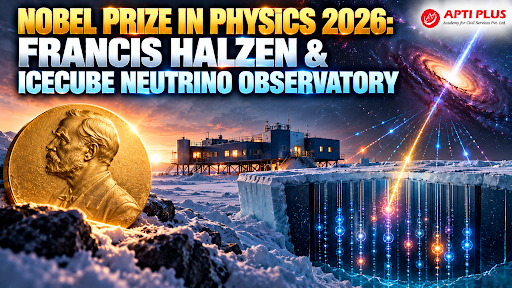
Why In News?
The Royal Swedish Academy of Sciences awarded the 2026 Nobel Prize in Physics to Prof. Francis Halzen of the University of Wisconsin–Madison for his contributions to the IceCube Neutrino Observatory and the discovery of high-energy neutrinos from astrophysical sources.
What are Neutrinos?
Neutrinos are tiny, electrically neutral subatomic elementary particles that have a very small mass and interact extremely weakly with matter.
-
Charge & Mass: They carry zero electric charge and possess a tiny, non-zero mass (proven by neutrino oscillation).
-
Classification: They belong to the lepton family of elementary particles and are not subject to the strong nuclear force.
-
Ghost Particles: Because they interact only via the weak nuclear force and gravity, trillions pass completely harmlessly and unnoticed through the human body every second.
-
Flavours: Neutrinos exist in three types or flavours: electron-neutrino, muon-neutrino, and tau-neutrino.
-
Neutrino Oscillation: They can dynamically change from one flavour to another as they travel through space and matter.
Major Sources
-
Natural: Core of the Sun (solar neutrinos), nuclear fusion in stars, supernovae explosions, cosmic rays hitting the atmosphere, and relic neutrinos from the Big Bang.
-
Artificial: Nuclear reactors and particle accelerators.
Significance
-
Cosmology: Studying them helps scientists understand the origin of the universe, stellar physics, and processes beyond the Standard Model of particle physics.
-
India-based Neutrino Observatory (INO): A proposed underground laboratory in Theni district, Tamil Nadu aimed at studying atmospheric neutrino oscillations.
What is Neutrino Astronomy?
Neutrino astronomy uses high-energy neutrinos as cosmic messengers to study violent astrophysical environments.
-
Direct Cosmic Path: Unlike charged cosmic rays, neutrinos are not deflected by magnetic fields. They can therefore travel almost directly from their sources.
-
Cosmic Accelerators: High-energy neutrinos can form when energetic protons interact with matter or photons, producing particles such as charged pions, which later decay into neutrinos.
-
Multi-Messenger Astronomy: Neutrinos complement electromagnetic radiation and gravitational waves, allowing scientists to study cosmic events through different signals.
How Does IceCube Detect Neutrinos?
-
Location: IceCube lies 1,450–2,450 metres beneath the Antarctic surface near the Amundsen-Scott South Pole Station.
-
Detector Network: It contains 86 strings and 5,160 Digital Optical Modules (DOMs) spread through nearly 1 cubic kilometre of clear ice.
-
Detection Process: When a neutrino collides with a particle in the ice, it produces charged particles that can generate Cherenkov radiation while travelling through the ice.
-
Digital Optical Modules: Photomultiplier tubes inside DOMs detect these faint light flashes and record their timing and intensity, helping scientists estimate the neutrino's energy and direction.
Francis Halzen's Contribution
-
Early Proposal: In 1988, Halzen proposed using deep Antarctic ice as a large-scale medium for detecting Cherenkov light from neutrino interactions.
-
AMANDA: He helped develop AMANDA, the predecessor to IceCube, which demonstrated the feasibility of drilling deep into Antarctic ice and operating optical sensors there.
-
IceCube Leadership: Halzen led the IceCube project as its Principal Investigator. Construction took place from 2004 to 2010, followed by full scientific operations in 2011.
-
Major Discovery: IceCube announced the detection of the first clear evidence of high-energy extraterrestrial neutrinos in 2013, opening a new era of neutrino astronomy.
Why are High-Energy Neutrinos Important?
-
Cosmic-Ray Mystery: They provide evidence that powerful astrophysical objects can accelerate particles to extremely high energies.
-
Blazar TXS 0506+056: In 2017, IceCube detected a roughly 290 TeV neutrino associated with a flaring blazar about 3.7 billion light-years away.
-
NGC 1068: In 2022, IceCube reported a significant neutrino excess from the active galaxy NGC 1068 (Messier 77).
-
Milky Way: IceCube has also provided evidence of diffuse neutrino emission from the Galactic Plane, helping scientists study high-energy processes within our own galaxy.
Source: THEHINDU
|
PRACTICE QUESTION Q. With reference to the Nobel Prize in Physics 2026, consider the following statements:
Which of the statements given above is/are correct? (a) 1 only (b) 1 and 2 only (c) 2 and 3 only (d) 1, 2, and 3 Answer: (a) Explanation Statement 1 is correct: The Royal Swedish Academy of Sciences awarded the 2026 Nobel Prize in Physics to Francis Halzen "for decisive contributions to the IceCube Neutrino Observatory and the discovery of high-energy neutrinos of astrophysical origin". Statement 2 is incorrect: Neutrinos lack an electric charge. This means they are not deflected by galactic or interstellar magnetic fields. Their ability to travel completely undisturbed in straight lines from their distant cosmic sources is precisely what makes them invaluable for directly tracking the origin of cosmic rays. Statement 3 is incorrect: The IceCube Neutrino Observatory is a cubic-kilometer-sized detector built deep inside the Antarctic ice at the South Pole (near the Amundsen-Scott South Pole Station), not in an underground mine in the Atacama Desert. |