Why In News?
Elon Musk recently accused Indian "oligarchs" of blocking Starlink's entry into India, a charge the government rejected, saying every satellite operator must pass the same regulatory process.
What Is Starlink And How Does It Differ From Ground Networks?
About Starlink
-
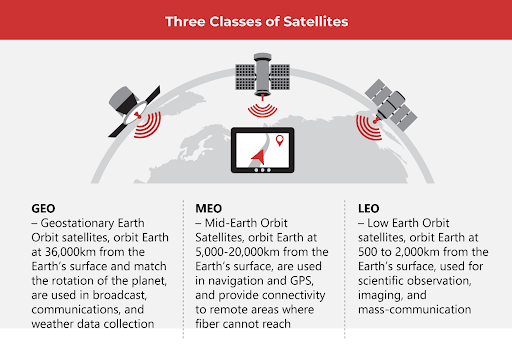
Satellite Internet: Starlink, run by SpaceX, provides internet through a large constellation of satellites in Low Earth Orbit (LEO), a few hundred kilometres above Earth.
-
Low Latency: Being close to Earth, LEO satellites offer faster response times than traditional geostationary satellites about 36,000 km away.
Reach Versus Density
|
Feature |
Fibre And Mobile Networks |
Starlink |
|
Optimised for |
Density: many users in one area |
Reach: remote areas without towers or cables |
|
Setup |
Slow and costly to build |
Quick to deploy |
|
Capacity limit |
High per area |
Limited per region |
- Capacity Limits: Starlink has previously stopped taking new residential customers in areas where it ran out of capacity, showing it cannot replace fibre in dense areas.
Where It Is Most Useful
-
Remote And Strategic Areas: Isolated settlements, border regions, ships and disaster-hit areas.
-
Military Use: It can connect soldiers, drones, sensors and command centres without ground infrastructure, giving it national security significance.
What Is India's Regulatory Framework For Satellite Internet?
Licensing And Authorisation
-
Licence: Starlink received a GMPCS (Global Mobile Personal Communication by Satellite) licence from the Department of Telecommunications (DoT) in 2025.
-
Space Regulator: IN-SPACe, the Indian National Space Promotion and Authorisation Centre set up in 2020, authorises private space activities.
-
Spectrum: The Telecommunications Act, 2023 allows administrative assignment of satellite spectrum rather than auction, and TRAI has recommended a framework for satcom spectrum pricing.
-
Other Players: Eutelsat OneWeb and Jio-SES have also obtained licences.
Security Conditions
-
Indian Gateways Only: Operators must route Indian user traffic through gateways (ground stations) located in India.
-
No Bypassing: They cannot use inter-satellite links to bypass Indian gateways or route traffic through gateways abroad.
-
Lawful Monitoring: They must provide monitoring facilities to Indian security agencies and restrict connectivity when ordered on security grounds.
-
Starlink's Response: Starlink has announced Indian gateway sites and India-specific data controls.
Legal Powers Of The State
-
Suspension In Emergencies: The Telecommunications Act, 2023 empowers the government to take over, suspend or intercept telecom services during a public emergency or in the interest of public safety.
What Risks Does Starlink Pose To India?
Limited Control
-
Who Holds The Switch: India can license and penalise Starlink, but SpaceX retains direct control over its satellites, software and terminal access.
-
Two-Way Risk: The network could stay active where India orders a shutdown, or be disabled when India needs it most.
Foreign Government Leverage
-
US Influence: SpaceX depends on American regulatory approvals and government contracts, giving Washington considerable leverage over the company.
The Enforcement Problem: Iran
-
Unauthorised Use: Since 2023, Iran has complained to the International Telecommunication Union (ITU) about Starlink terminals operating on its soil without permission.
-
ITU's Limits: At its October 2026 meeting, the ITU's Radio Regulations Board noted the transmissions were continuing, but said it lacked authority to suspend the relevant frequency assignments.
Dependence In Conflict: Ukraine
-
Cooperation: In February 2026, Ukraine worked with SpaceX to block Starlink terminals used by Russian forces.
-
Disruption: In October 2026, Ukrainian officials reported that Starshield, SpaceX's military service, began losing connectivity on terminals moving faster than about 160 km/h, disrupting drone missions and frontline logistics.
-
Contested Cause: Reuters reported, citing officials, that the order came from within the White House, which the US President denied personally issuing. The episode coincided with US pressure on Ukraine over strikes on Russian refineries.
What Are The Key Challenges?
Verifying Compliance Independently
-
Hidden Routing: Indian authorities can inspect domestic gateways, but verifying whether Indian traffic is routed through foreign gateways or mirrored abroad via satellite links is difficult.
-
Dependence On Disclosures: Verification partly depends on information provided by SpaceX itself.
Trade-Off Between Security And Resilience
-
Lost Redundancy: Starlink's strength is that satellites can pass traffic between themselves if a ground station fails. India's rules prevent rerouting through foreign gateways, so if Indian gateways fail, service could stop.
Weak Domestic Ground Connectivity
-
Gaps In BharatNet: A parliamentary review found that only 30% of gram panchayats had a functional BharatNet connection as of February 2026, leaving many communities with few alternatives to satellite internet.
Limited Indian Satellite Capacity
-
Dependence On Foreign Launchers: India still relies on foreign launch providers for some heavy communication satellites.
-
Example: ISRO's high-throughput broadband satellite GSAT-N2 was launched in November 2024 on a SpaceX Falcon 9 rocket, as India's own rockets could not yet lift its weight, showing the gap in domestic heavy-lift capacity.
Concentration Of Global Power
-
Few Dominant Players: The LEO broadband market is dominated by a handful of companies and countries, limiting choice for nations like India.
-
Spectrum And Orbit Crowding: Early movers occupy valuable orbital slots and spectrum, making it harder for later entrants.
Space Sustainability
-
Orbital Congestion: Thousands of LEO satellites raise the risk of collisions and space debris.
-
Astronomy Impact: Satellite brightness and radio emissions interfere with astronomical observations.
Political And Commercial Controversy
-
Public Dispute: Public exchanges between Starlink's owner and Indian business interests risk turning a security issue into a debate about personalities and competition.
What Is The Way Forward?
Retain Strict Licensing, Strengthen Verification
-
Keep Safeguards: Maintain gateway localisation and lawful monitoring rules.
-
Independent Checks: Build technical capacity to verify traffic routing independently, through network audits and monitoring tools.
Multiple Providers From Different Jurisdictions
-
Avoid Single-Vendor Dependence: Use more than one satellite internet provider, from countries under different jurisdictions, so no single company or government can cut off access.
-
Learn From Europe: Strategic autonomy in space is a global concern.
-
Example: The European Union is building IRIS², its own secure satellite constellation worth about €10.6 billion, to reduce dependence on non-European providers for government and defence communications.
Backup Plans For Essential Users
-
Redundancy: Military, disaster response and essential services should maintain backup connections and tested procedures for switching between them.
Build Indian Satellite Constellations
-
Domestic Constellations: Encourage Indian companies to build LEO constellations and use their demand for satellites and rockets to grow domestic industry.
-
Policy Support: Use the Indian Space Policy, 2023 and liberalised FDI rules in space to attract investment.
-
Strategic Lesson: Owning critical space systems has proven valuable before.
-
Example: India developed NavIC, its own regional navigation system, partly because of concerns about depending on foreign systems like GPS during crises, a similar logic now applies to satellite internet.
Expand Ground Networks
-
Complete BharatNet: Fast-track the Amended BharatNet Programme so that fewer communities depend solely on satellite internet.
Global Rules And Diplomacy
-
Strengthen ITU Rules: Push for stronger international mechanisms to address unauthorised satellite transmissions and enforce national sovereignty over spectrum.
-
Space Traffic Management: Support global norms on orbital debris and space sustainability.
Grow Indian Launch Capacity
-
Heavy-Lift Rockets: Develop India's next-generation launch vehicles to reduce reliance on foreign rockets for large satellites.
-
Private Launch Firms: Support Indian private launch companies to expand capacity and lower costs.
Conclusion
While Starlink offers vital connectivity for India's remote regions, borders, and disaster zones, foreign ownership poses national security risks. To mitigate these, India must balance robust oversight and verification with multi-provider redundancy, backup protocols, expanded ground infrastructure, and indigenous satellite constellations to safeguard communication resilience.
Source: THEHINDU
|
PRACTICE QUESTION Q. What are the national security implications of allowing foreign satellite internet providers like Starlink to operate in India? (10 Marks, 150 Words) |