Why In News?
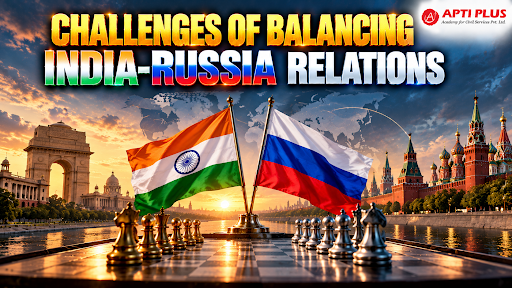
India's transactional multi-alignment across competing global forums risks straining its foundational strategic trust and defense partnership with Russia.
Historical Background of India-Russia Relations
India-Soviet Union Treaty of Peace, Friendship and Cooperation, 1971
-
Diplomatic & Security Shield: Signed in 1971, during the East Pakistan crisis, the treaty provided India with vital strategic backing against an emerging US-Pakistan-China geopolitical axis.
-
UN Veto Support: The treaty included security consultation clauses that deterred external intervention during the 1971 Bangladesh Liberation War, while Soviet vetoes in the UN Security Council consistently blocked hostile ceasefire resolutions.
Soviet Support during the Cold War
-
Sovereignty & Territorial Integrity: Moscow supported India's sovereignty over Jammu & Kashmir and Goa, mediated the 1965 Tashkent Declaration, and provided critical diplomatic balance during regional crises.
-
Industrial & Space Foundations: Soviet financial and technical aid funded foundational heavy industrial projects, including the Bhilai (1955) and Bokaro steel plants, state-owned heavy engineering works, and the launch of India's first satellite, Aryabhata, in 1975.
India’s Defence Cooperation with Russia
-
Defense Inventory Backbone: During the Cold War, the USSR became India's primary defense supplier, accounting for over 70% of military equipment imports.
-
Shift to Joint Manufacturing: Over decades, the relationship transitioned from direct off-the-shelf armaments purchases to licensed production (T-90 tanks, Su-30MKI fighter aircraft) and joint research and development ventures.
Declaration on Strategic Partnership, 2000
-
Post-Cold War Institutional Reset: Signed during President Vladimir Putin's visit to New Delhi, the Declaration re-anchored bilateral ties following post-Soviet disruptions.
-
Annual Summit Architecture: It institutionalised annual leadership summits, established Intergovernmental Commissions (IRIGC), and built structured cooperation in defense, nuclear energy, space, and counter-terrorism.
Special and Privileged Strategic Partnership, 2010
-
Elevated Strategic Ties: In 2010, the bilateral relationship was formally upgraded to a 'Special and Privileged Strategic Partnership,' reflecting an exceptionally high level of strategic trust.
-
Extended Military & Nuclear Frameworks: This framework facilitated 10-year Military-Technical Cooperation agreements (most recently 2021–2031), Kudankulam nuclear plant expansion, and the inauguration of the 2+2 Foreign and Defence Ministerial Dialogue in 2021.
What Is the Current Challenge in India-Russia Relations?
Deepening Engagement with Western Nations: India's growing strategic closeness to the US—driven by Indo-Pacific alignment, Quad engagement, iCET initiatives, and $128+ billion in bilateral trade—creates strategic discomfort in Moscow.
Defence Sourcing Diversification: India's conscious efforts to expand arms purchases from France (Rafale, Scorpène), Israel (drones, radars), and the US have gradually reduced Russia's traditional market share in Indian defense acquisitions.
Russia’s Expectations of Political Solidarity: Moscow expects stronger diplomatic alignment from a long-standing partner, whereas New Delhi maintains a strictly independent, national interest-based posture.
Navigating the Ukraine Conflict Position: India maintains diplomatic neutrality—abstaining from UN Security Council and General Assembly votes condemning Russia, refusing to join unilateral sanctions, while advocating dialogue, respect for sovereignty, and stating that 'this is not an era of war'.
Middle East Diplomatic Equilibrium: India balances defense and technology ties with Israel alongside political dialogue with Iran at SCO platforms, maintaining a delicate regional equilibrium.
Western Sanctions & Compliance Friction: SWIFT bans on Russian banks, US CAATSA regulations, G7 price caps, and shipping insurance restrictions create severe operational hurdles for cross-border financial clearing and trade execution.
Russia-China Strategic Convergence: Driven by Western isolation, Russia's growing economic, military, and technological dependency on Beijing raises concerns in New Delhi regarding Moscow's reliability during potential Sino-Indian border escalations.
Divergent Views on World Order & Regional Security: India views multipolarity as an inclusive, reform-oriented structure to balance major powers, whereas Russia views it primarily through an anti-Western prism.
-
Similarly, Russia critiques the 'Indo-Pacific' construct as a containment mechanism, whereas India views it as crucial for maritime security.
Mutual Strategic Importance: Why Russia and India Need Each Other
Why Is Russia Important for India?
Military Hardware & Operational Readiness: Russia supplies 60%–65% of India's defense inventory and provides essential original equipment manufacturer (OEM) support, engine overhauls, and spare parts for Su-30MKI fighters, T-90 tanks, and S-400 systems.
Energy Security & Inflation Buffer: Discounted Russian crude, natural gas, and fertilizers stabilize domestic fuel prices, reduce import bills, and secure agriculture.
Reliable Civil Nuclear Expansion: Rosatom remains the only foreign operational constructor building large-scale nuclear reactors at Kudankulam.
Eurasian & Continental Access: Russia opens strategic corridors into Central Asia, the Arctic, and the Russian Far East (RFE), preventing total Chinese hegemony across continental Eurasia.
Diplomatic Balancing & UNSC Veto: Moscow offers historical diplomatic backing in the UNSC and reinforces India's multipolar strategic weight.
Why Is India Important for Russia?
Major Asian Market & Revenue Source: India absorbs 38%–40% of Russia's seaborne crude exports, providing vital revenue to the Russian state budget amid European trade loss.
Defense Industrial Sustenance: Long-term Indian military orders, joint production contracts, and licensing fees sustain Russian defense-industrial complexes.
Trade Re-routing & Currency Diversification: India offers an alternative trade portal, aiding Russian efforts to experiment with non-dollar Rupee-Rouble mechanisms and Special Vostro Accounts.
Multilateral Legitimacy in BRICS & SCO: Active Indian participation demonstrates that Western efforts to isolate Russia internationally have failed.
Eurasian Connectivity Nodes: India acts as a crucial southern terminus for the International North-South Transport Corridor (INSTC) and the Chennai-Vladivostok Eastern Maritime Corridor.
How Strategic Autonomy Shapes India’s Foreign Policy?
Meaning: Strategic Autonomy is the statecraft principle whereby a nation retains full freedom of action in foreign policy and security decisions based strictly on sovereignty and national interest, without adhering to formal military alliances or external coercion.
Evolution from Non-Alignment to Multi-Alignment: Indian foreign policy has evolved from Cold War non-alignment (equidistance) to pragmatic multi-alignment—summarized as 'convergence with many, congruence with none'.
Sovereign & Independent Decision-Making: Reflected in New Delhi's decision to maintain Russian oil purchases and defense ties despite Western diplomatic and sanction pressures.
Issue-Based International Partnerships: India engages contrasting groups simultaneously—partnering with the Quad for maritime security in the Indo-Pacific, while coordinating with BRICS and the SCO for continental Eurasian economic stability.
Protection of Vital National Interests: Prioritising domestic energy security, inflation containment, economic growth, and military readiness along the Line of Actual Control (LAC) over ideological alignment.
Avoiding Single-Power Dependence: Deliberately diversifying partnerships across the US, Russia, Europe, Japan, and the Global South to prevent over-reliance.
Strategic Autonomy vs Diplomatic Neutrality: Strategic Autonomy is not passive neutrality; it is proactive, interest-driven engagement designed to maximize national leverage.
What Are the Major Risks of India’s Balancing Act?
Erosion of Mutual Trust: Multi-alignment risks creating friction with Moscow over India's Western closeness, while frustrating Western partners expecting explicit alignment against Russian aggression.
Perception of Selective Diplomacy: Critics allege inconsistency in India's vocal support for territorial integrity in some regions while maintaining silence in others.
Pressure from Western & Secondary Sanctions: Heightened compliance oversight under US CAATSA rules and EU restrictions threatens Indian financial institutions, refineries, and shipping firms.
Disruption of Defence Supply Chains: The Ukraine war strains Russian defense production, delaying deliveries of S-400 squadrons, spare parts, and overhaul kits.
Russia-China Strategic Convergence: Russia's economic dependency on Beijing may compromise its neutrality or willingness to supply advanced arms to India during Sino-Indian border crises.
Uncertainty in Energy Trade & Payment Systems: Volatile crude price discounts, freight costs, and payment imbalances (such as excess Rupee accumulation in Vostro accounts) create ongoing operational friction.
Way Forward
Uphold Strategic Autonomy & Multi-Alignment: Reconcile interest-driven diplomacy with diplomatic consistency, maintaining freedom of choice without submitting to binary global power blocs or external coercion.
Strengthen Institutional Communication with Russia: Utilize existing mechanisms like the 2+2 Ministerial Dialogue and IRIGC-TEC sessions to resolve payment hurdles, address trade asymmetries, and manage perception gaps with Moscow.
Accelerate Defence Indigenization & Diversification: Aggressively expand domestic manufacturing of critical spare parts and platforms under Atmanirbhar Bharat and Make in India, while gradually broadening arms procurement across France, Israel, the US, and private Indian defense firms to reduce single-source reliance.
Correct Trade Imbalances & Payment Frameworks: Boost Indian exports in pharmaceuticals, machinery, organic chemicals, and agricultural products, while advancing the India-EAEU Free Trade Agreement (FTA) roadmap and establishing sanction-resistant national currency settlement corridors.
Adopt a "Portfolio Approach" to Energy Security: Diversify energy procurement across West Africa, Iraq, and the Americas, expand domestic Strategic Petroleum Reserves (SPR), and explore clean energy collaboration in Small Modular Reactors (SMRs) and green hydrogen.
Leverage De-hyphenated Multilateral Diplomacy: Deepen technological, economic, and Indo-Pacific maritime security ties with Western partners via iCET and the Quad, while using BRICS and the SCO to maintain Eurasian continental stability and advocate for multipolar global governance and UNSC reform.
Conclusion
India must balance pragmatic ties with Russia and strategic partnerships with the West, using Strategic Autonomy to safeguard national security, economic resilience, and sovereign decision-making in a multipolar world.
Source: THEHINDU
|
PRACTICE QUESTION Q. India’s strategic autonomy depends on maintaining partnerships without becoming dependent on any single power. Examine the challenges in balancing India-Russia relations with growing engagement with Western countries. 250 WORDS |